
Independent Evaluation | August 11, 2026
Structured™ evaluated OpenAI’s publicly available digital information using The Structured Framework™.
The evaluation examines five structural dimensions: Organization, Representation, Consistency, Continuity, and Clarity.
The resulting Structured Score™ is 84/100 — Strong.
Structured Score™: 84/100 — Strong
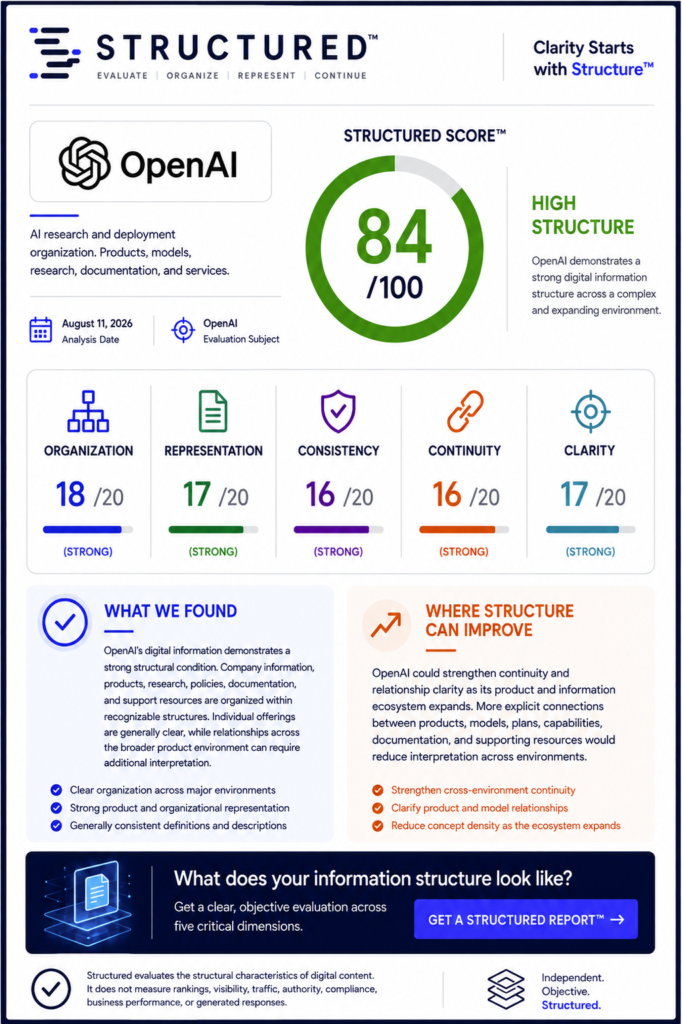
The evaluation found a strong overall information structure with clear organization, recognizable representation, and generally consistent information across the evaluated environment.
The primary opportunities identified involve maintaining continuity and relationship clarity as OpenAI’s product and information ecosystem continues to expand.
Dimension Scores
Organization — 18/20 | Strong
OpenAI maintains clear organizational separation across major information environments. Company information, products, research, business offerings, policies, documentation, and support resources are generally organized within recognizable structures.
Representation — 17/20 | Strong
OpenAI’s organizational identity, products, services, and major concepts are clearly represented. Individual offerings are generally distinguishable, although the expanding product environment increases the importance of maintaining explicit relationships between them.
Consistency — 16/20 | Strong
Core organizational definitions, mission language, and major product descriptions remain generally consistent. Some terminology density develops as products, models, plans, capabilities, and supporting services evolve.
Continuity — 16/20 | Strong
Relationships between major information environments are generally maintained. Continuity becomes less explicit when moving between company information, products, models, plans, documentation, and individual capabilities.
Clarity — 17/20 | Strong
Individual information resources are generally clear and understandable. The primary clarity challenge comes from concept density rather than unclear individual explanations.
Principal Finding
OpenAI’s digital information demonstrates a strong structural condition.
The evaluation identified a distinction between strong individual definitions and somewhat weaker relationship clarity across the broader information environment.
Information generally explains what something is clearly.
More interpretation can occasionally be required to determine where it belongs, how it relates to other offerings, and how those relationships extend across different information environments.
Where Structure Can Improve
Three primary opportunities were identified:
Cross-Environment Continuity
Strengthen connections between related information across major platforms, documentation, product environments, and supporting resources.
Relationship Clarity
Make relationships between products, models, plans, capabilities, and other offerings more explicit.
Concept Density
Continue simplifying and standardizing complex concepts as the product ecosystem expands.
These findings do not indicate poor information quality. They identify structural conditions where additional clarity and continuity could strengthen an already strong information environment.
About the Evaluation
The Structured Score™ is a composite score based on evaluation across five dimensions of The Structured Framework™:
Organization · Representation · Consistency · Continuity · Clarity
The evaluation is based on publicly available information and observable structural characteristics.
This is an independent evaluation. OpenAI did not commission, participate in, endorse, or approve this evaluation.
About Structured Evaluation Reports™
Structured Evaluation Reports™ provide an objective assessment of the structural characteristics of digital information.
They are designed to identify how information is organized, represented, maintained, connected, and understood—and where structural improvement may be beneficial.
Learn more about Structured Evaluation Reports™ →
Independent. Objective. Structured.
Structured evaluates the structural characteristics of digital information. It does not measure rankings, visibility, traffic, authority, compliance, business performance, or generated responses.